Mens clothes are not a secret code reserved for a different body or a different kind of shopper. They are simply garments built with different assumptions: longer sleeves, straighter side seams, roomier shoulders, and fewer decorative details. Those assumptions can be useful when your closet needs a crisp shirt for a client meeting, a durable sweater for school drop-off, or a jacket that does not collapse after one season.
I learned to look at mens clothes as a designer, not as a costume. The question is never whether a woman can wear something from the men's department. She can. The useful question is whether the garment gives you the proportion, fabric, and movement you need. Every piece earns its hanger, and a good borrowed piece often earns it faster than a trendy women's item.
Start with the pieces that already work
The easiest entry point is a cotton button-down. Look for an Oxford cloth shirt from Brooks Brothers, Uniqlo, Gap, or J.Crew Factory. A men's medium may give you the shoulder width and sleeve length you want, while the generous body creates an intentional half-tuck over straight-leg jeans. For a neater line, try a men's small and compare the armhole. The shoulder seam should sit close to your shoulder bone rather than dropping halfway down your arm.
Sweaters are another dependable category. Mens clothes often use denser knits because the design brief assumes repeated wear rather than a delicate drape. A merino crewneck from Lands' End or L.L.Bean can sit over a collared shirt, under a blazer, or beside a midi skirt. Check the ribbing at the cuff and hem. If it springs back after you stretch it gently, the sweater has a better chance of keeping its shape through a school-week rotation.
Do not ignore the men's accessories wall. A leather belt with a simple brass buckle, a wool scarf, or a canvas tote can bring structure to an otherwise soft outfit. These are low-risk experiments, especially if you are not ready to change your silhouette.

Fit is a set of measurements, not a label
Sizing is where mens clothes become either wonderfully practical or deeply annoying. A men's 12-inch rise does not translate neatly to a women's size, and a labeled medium tells you almost nothing without the garment's actual measurements. Bring a soft tape measure or compare the item with something you already own.
For shirts, measure pit to pit, shoulder to shoulder, sleeve length, and back length. A shirt that fits across the shoulders but hangs too far below your seat can be shortened by a tailor. A shirt that is tight across the upper back is harder to rescue. For trousers, measure the waistband flat, then double it, and check the front rise. A higher rise can work beautifully with a tucked sweater, but too much fabric at the front will create bunching when you sit in the carpool line.
The best mens clothes do not need to look oversized. Fit the strongest point first. If the shoulder is correct, sleeves can be rolled or altered. If the waist is correct, a tailor can often adjust the seat. A $25 to $45 sleeve alteration can turn a $60 sale blazer into a jacket you wear twice a week.
Choose fabric before color
Color gets most of the attention on a shopping rack, but fabric determines whether a garment belongs in your actual life. A 100 percent cotton Oxford shirt will wrinkle more than a cotton-polyester blend, but it also develops a softer hand over time. For travel, a shirt with roughly 60 percent cotton and 40 percent polyester can be easier to wash and hang dry. It will not have the same crisp texture, so decide whether convenience or natural hand matters more for that purchase.
With sweaters, look for merino wool, cotton, or a blend with a modest amount of nylon for durability. I am cautious with acrylic-heavy knits. They can feel pleasant under store lighting and then pill across the stomach after three wears. Check the underarm and side seam for loose fuzz before buying. For jackets, cotton twill and wool blends usually offer more useful structure than thin polyester shell fabric.
This is where mens clothes can outperform impulse purchases: the fabric story is often straightforward. A $90 wool-blend overshirt from Banana Republic Factory may serve more situations than a $140 fashion jacket with an elaborate sleeve and no usable pocket.
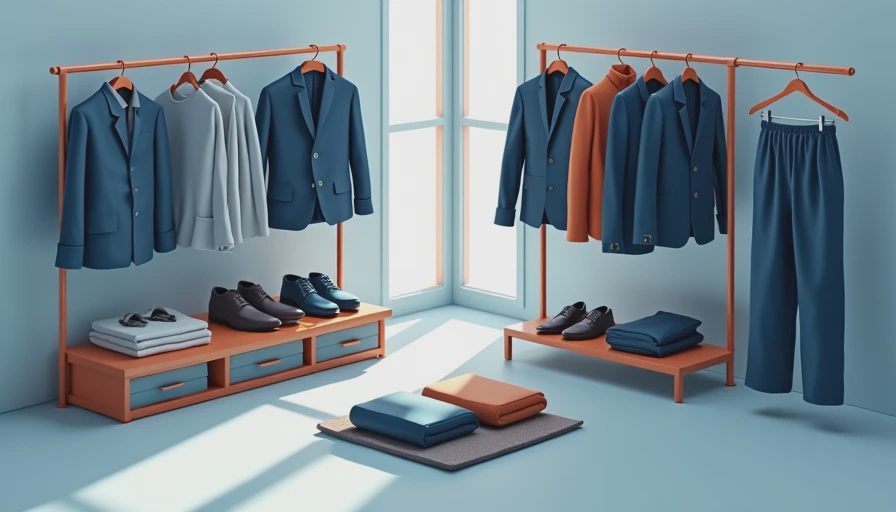
Build an outfit instead of collecting odd pieces
A men's shirt only earns space when it connects to the rest of your wardrobe. Try an indigo Oxford with black trousers and loafers for a presentation. Wear the same shirt open over a white tank with jeans for dinner. Push the sleeves to just below the elbow and add a watch; the proportion becomes deliberate rather than borrowed.
A crewneck sweater can bridge seasons. In Richmond, I wear a navy merino crewneck over a striped shirt in January, then over a cotton dress when an air-conditioned office turns frigid in July. The important detail is hem placement. If the sweater ends at the widest part of your hips and the shirt extends another six inches, the layers can look accidental. Either tuck the shirt neatly, shorten the sweater with a small fold, or choose a shirt with a curved hem that is meant to show.
Jackets require more attention. A men's blazer often has a longer body and wider sleeve, which can look excellent with a column of color underneath. A charcoal jacket over a black knit dress gives you clean vertical lines for dinner. With wide-leg trousers, however, a long oversized blazer may create too much volume. Choose a shorter chore jacket or roll the sleeves to expose the wrist.
What to skip at the rack
Not every category transfers well. Men’s dress pants often have a front construction that assumes a different hip-to-waist relationship, and alterations can become expensive quickly. If the waistband fits but the seat pulls, walk away rather than planning a miracle. Men’s graphic tees can also be too long and too square unless you specifically want a relaxed sleepwear-adjacent shape.
Be careful with heavily structured suit jackets. The chest canvas, button position, and sleeve pitch are designed around a different torso. A thrifted blazer for $35 is not a bargain if tailoring costs another $100 and the button still lands in the wrong place. Denim, shirts, sweaters, belts, and casual jackets are usually better starting points.
When comparing mens clothes with women's versions, do not assume the men's item is automatically better. Sometimes a women’s shirt has the dart placement and shoulder angle that make it easier to move in. Sometimes the men's version wins because it uses a heavier fabric and a real pocket. Inspect both. The goal is not to shop by department; it is to identify the garment that solves your problem.
A practical fitting-room routine
Take three pieces into the fitting room: one size that seems right, one smaller, and one larger. Fasten every button, raise your arms, sit down, and reach forward as if you are lifting a child into a car seat. Look at the back, not only the mirror image from the front. Check whether the collar stands away from your neck, whether the armhole cuts in, and whether the hem stays put when you move.
Then make one complete outfit. Pair the shirt with your own trousers and shoes. Add your everyday coat. If the item works only with a new belt, new pants, and a special bra, it has not earned its hanger yet. Mens clothes should expand your options, not create a second shopping list.
My favorite test is a Tuesday test. Imagine wearing the garment for an ordinary workday, not a carefully styled photograph. Can you get coffee, answer email, pick up groceries, and sit through dinner without adjusting it every ten minutes? If yes, you have found something useful. If not, leave it on the rack, regardless of the discount.
The best wardrobe is not divided neatly between men's and women's departments. It is divided between garments that support your life and garments that demand a performance. Start with a shirt, sweater, or jacket, inspect the construction, and adjust the fit where it matters. Good mens clothes can give a compact closet more range without sending you into a seasonal buying spiral. That is the standard I use in my own Richmond closet, and it is still simple: every piece earns its hanger.



No comments yet — be the first to share a thought.