As a former J.Crew designer, I spent years in fit sessions asking one question: will this piece still earn its hanger in three years? Most pieces don't. A work capsule wardrobe flips the question. Instead of asking what's new, you ask what's necessary. And that shift changes how you dress for your job every single morning.
I've edited closets for teachers, marketers, lawyers, and nonprofit directors. They all start the same way: a closet full of clothes they never wear and a handful of things they wear to death. The fix is not "shop smarter." The fix is building a small, deliberate set of pieces that mix and match so every outfit feels finished.
Why Your Closet Feels Empty Even When It's Full
The scenario goes like this: you have a 9 a.m. presentation, a working lunch, and school pickup by five. You open the closet and feel the familiar pang — nothing works. The problem isn't volume. It's that the pieces don't talk to each other. A black blazer that only matches one pair of pants. A gray top that clashes with everything except that one skirt. A dress that needs a special cardigan. Each outfit is an island.
A work capsule wardrobe is the opposite: it's an ecosystem. Every piece pairs with at least three other pieces, so you get dozens of outfits from just ten items. That's the whole point. You stop choosing between obvious and invisible and start choosing between outfits that actually look intentional.
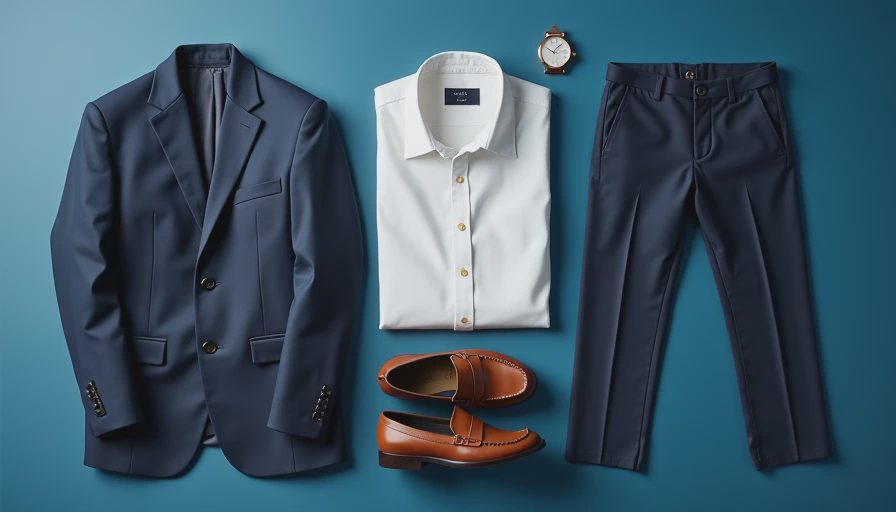
The 10-Piece Starting Formula I Use With Clients
When I sit down with a client in Richmond, I don't start by pulling clothes. I start by asking how she actually spends her week. Do you sit at a desk all day? Do you present to clients? Are you on your feet at school events? The answers change the exact pieces, but the starting formula stays close to this: one blazer, one coat, two pairs of trousers, one dark-wash straight jean, three tops, one dress, and one pair of shoes. That's ten pieces. Accessories are freebies.
Let me give you real examples, with prices you can verify. For a blazer, a black stretch wool option from Quince runs about $148, and it's cut like a much more expensive jacket. If you're on a J.Crew budget, the Kate blazer regularly hits 40% off, which brings it just under $100. For trousers, the Everlane Day Trouser at $118 is a workhorse, and the Uniqlo Wide Leg Pant at $40 is the best budget start. For tops, choose a white cotton poplin button-down — J.Crew's classic oxford is still great — a silk shell from MM.LaFleur, and a fine-gauge knit from Amour Vert. Add a sheath dress from Eileen Fisher in stretch jersey and a pair of black lug-sole loafers from Solovair or a flat leather loafer from G.H. Bass.
The exact labels don't matter as much as the proportions. Every piece should be in the same tonal family — navy, black, camel, white, and one accent like olive or rust — so they all blend.

Choosing Fabrics That Survive Real Workdays
Every work capsule wardrobe I build starts with fabric, not color. I can tell you from designing clothes for a living that polyester blends are the reason your pants look tired by 2 p.m. And cotton couture? Not a thing. Here's the short version: look for 100% cotton poplin, wool crepe, silk charmeuse, and ponte di roma knits. These fabrics hold their shape, breathe, and don't need to be ironed every day.
Test fabric right in the store. Crush a fistful of the garment for ten seconds. Let go. If it springs back without lines, it will survive a workday. If it stays crushed, it will look like you slept in it by noon. That test is better than any brand name, and it's the one I use on every client shopping trip.
The One Rule That Keeps a Capsule From Falling Apart
A work capsule wardrobe only works if every new piece earns at least three outfits. Before you hand over your card, hold the item up against the rest of your capsule. Can you wear it with three of your existing bottoms and two of your shoes? If the answer is no, leave it in the store. That includes sale racks. I still finish client closets and watch them get tempted by a gorgeous sequined skirt. If it doesn't pair with the rest of the capsule, it's not a capsule piece — it's a costume waiting for a party you don't attend.
The other rule is about wear. Track which pieces you reach for over three weeks. Anything you didn't touch gets edited out. Anything you wore three times a week becomes the anchor for the next season.
The Four Mistakes That Derail a Capsule
First, buying too many variations of one color. You don't need four black turtlenecks; you need one great one in a fabric that holds up. Second, ignoring your shoes and bag. A capsule that's all clothes and no footwear will leave you digging in the back of the closet every morning. Third, saving pieces for "good" — a pair of white jeans that never gets worn because it might get dirty. Clothes are made to be worn. If you can't live in them, they don't belong in the capsule.
And fourth, thinking a capsule is a punishment. It's not. It's a relief. A woman I worked with last spring went from 180 pieces down to forty, and she told me the first week felt like a vacation. She wasn't sacrificing choices. She was finally making the good choices visible.
A Real Week in a 10-Piece Work Capsule
Let me show you what this looks like in practice. Monday: the silk shell, the navy trousers, and the blazer. Tuesday: the sheath dress with the loafers. Wednesday: the fine-gauge knit, the dark-wash jeans, and the camel coat over everything. Thursday: the white poplin shirt with the same trousers, plus the blazer again. Friday: the knit shell with the trousers, no blazer, and a bold earring. That's five distinct looks from a handful of pieces, and any of them works for a client lunch, a school meeting, or a dinner out.
That's the real promise of a work capsule wardrobe. It doesn't mean wearing the same uniform every day. It means wearing a system so well edited that you stop thinking about what to wear entirely — and instead walk out the door looking like you planned it.
If you want help building your own, I host one-on-one edit sessions at my Richmond studio and over video. We'll pull everything out of your closet, sort what actually earns its hanger, and build a list of the few things worth buying. Every piece earns its hanger, and so does every minute you spend getting dressed.




No comments yet — be the first to share a thought.